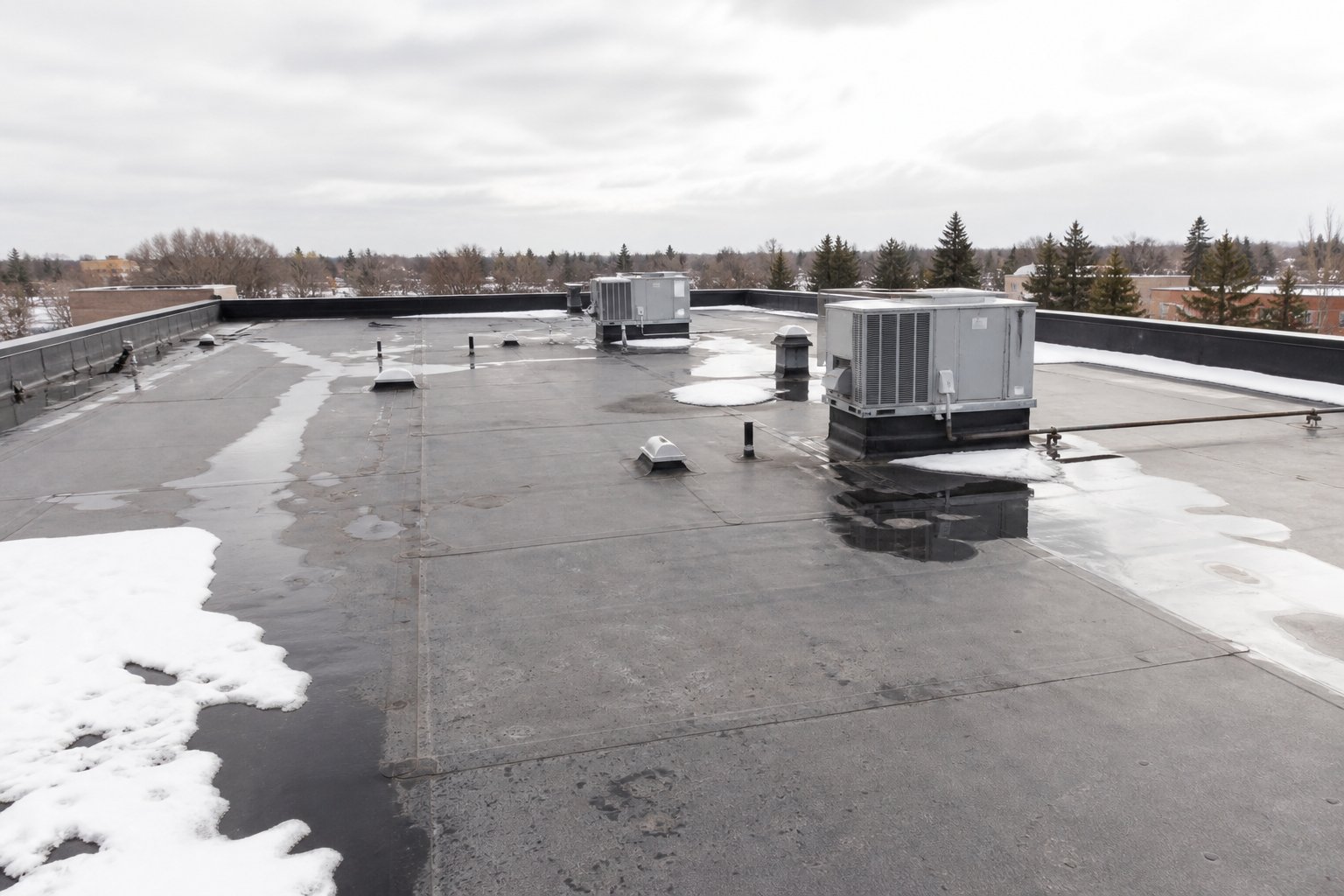
Winter in Michigan does not go easy on flat roofs. Months of freeze-thaw cycles, heavy snow loads, ice damming, and temperature swings that move 40 degrees in a single day leave behind damage that is not always visible from the ground. Spring is when that damage shows itself - and when catching it early makes the difference between a straightforward repair and a significant replacement conversation.
A spring inspection is not optional maintenance for Michigan flat roofs. It is the most important service call of the year. Here's a complete spring flat roof inspection Michigan checklist.
Spring Flat Roof Inspection Michigan Checklist
Start From the Inside
Before anyone walks on the roof surface, check what is happening inside the building directly below it.
Water stains on ceiling tiles or drywall are the most obvious signal. Fresh stains are darker at the edges and lighter toward the center. Old stains that dried and reactivated look uniform in color. Either one means water has been moving through the roof assembly at some point, recently or repeatedly.
Check the tops of walls near the roofline for moisture streaking. Look at light fixtures and HVAC vents that penetrate the ceiling. Water follows the path of least resistance and often shows up at those points before it appears anywhere else. If the building has an accessible attic or plenum space above the ceiling, get eyes in there before stepping onto the roof. Wet insulation, rust stains on structural members, and daylight visible through the deck are all findings that change the scope of what needs to happen next.
Walk the Roof Surface Carefully
Once you are on the roof, take your time. Move slowly and pay attention to what is underfoot as much as what is visible ahead.
Membrane Condition
The membrane is the first line of defense for everything below it. Look for cracking, splitting, or blistering across the surface. Blisters mean moisture has gotten beneath it and been trapped. They grow with every freeze-thaw cycle and do not resolve on their own.
Check for shrinkage at the perimeter. A membrane that has pulled back from the edge of the roof or from flashing transitions has reached the end of its functional life in those areas. Patches applied over previous repairs are worth examining closely.
Seams and Lap Joints
Run your hand along every seam you can access. A seam that feels solid and flat is holding. One that has any give, lifting, or separation at the edge is a water entry point waiting to be used. Michigan winters work seams hard. Even a seam that was performing fine in October may have opened slightly by March after a season of freeze-thaw movement.
Ponding Areas
Standing water on a flat roof after rain or snowmelt is normal for a short period. Water that sits for more than 48 hours points to a drainage problem. Walk the surface looking for low spots - areas where the membrane surface shows a bowl shape or where debris and dirt have collected in a ring pattern from previous ponding events. Those rings tell you exactly where water has been sitting repeatedly, even if the roof is dry when you inspect it.
Check Every Penetration
Penetrations are where most flat roof leaks originate. Every pipe, vent, drain, HVAC curb, skylight, and exhaust stack that punches through the membrane is a potential failure point.
Check the flashing around each one. Flashing should be firmly adhered, sealed at the edges, and show no signs of cracking or pulling away from the penetrating element. A flashing that has separated even slightly creates a gap that collects water and channels it directly into the roof assembly with every rain event.
Roof drains need specific attention after winter. Debris, leaves, and sediment accumulate in drain bowls through fall and winter. A partially blocked drain causes water to back up and pond across a larger area than it would with a clear drain. Clean every drain and confirm water flows through it freely.
HVAC curbs take significant freeze-thaw stress because they are elevated above the roof surface and exposed on multiple sides. Check the flashing at the base of every curb completely around its perimeter. A gap on the downslope side of a curb is particularly serious because water running across the roof surface collects directly against it.
Inspect the Perimeter and Parapets
The perimeter of a flat roof takes more concentrated stress than the field of the roof. Wind uplift, thermal movement, and freeze-thaw cycling all hit hardest at the edges.
Check coping caps on parapet walls for movement or gaps between sections. Coping that has shifted or separated allows water to enter the top of the wall and travel down into the building assembly - a path that is often difficult to trace back to the source once it is happening. Check the interior face of parapet walls for efflorescence - the white mineral deposit left behind when water moves through masonry and evaporates. It is a reliable indicator of water infiltration through the wall.
Edge metal and gravel stops at the roof perimeter should be firmly secured with no lifting, bending, or separation from the membrane below. A loose edge detail on a Michigan roof is one windstorm away from becoming a larger problem.
Document Everything You Find
A spring inspection is only as useful as what you do with the findings.
Photograph every problem area before leaving the roof. Flag areas that need immediate attention separately from areas that warrant monitoring through the season.
If multiple issues are present, prioritize by risk. Active water entry points and failed flashings around penetrations are urgent. Surface cracking without membrane penetration and minor ponding areas are watch items that can be scheduled. Structural concerns - soft decking, visible deflection, signs of rot - move to the front of the list regardless of everything else.
Final words
We hope this spring flat roof inspection checklist is helpful for building owners and property managers. A visual inspection helps to detect issues quickly, but it does not catch everything.
A professional spring inspection includes probing seams under tension, core cuts to check insulation moisture content, and infrared scanning in some cases to identify wet insulation that is not visible from the surface. If the interior inspection found stains, if the roof is more than 15 years old, or if last winter was particularly severe, a professional assessment gives you a complete picture that a surface walkthrough cannot. You can use this guide for flat roof inspections in West Michigan.
Published by Flat Roof Waterproofing Solutions -- certified industrial roofers serving commercial properties across West Michigan. Based in Grand Haven, MI. Call (616) 947-7652 to schedule a free inspection.