Commercial roof leaks tend to show up in the middle of January. Snow load stress opens a seam during a heavy storm. An ice dam backs water into the building overnight. By the time a tenant reports the ceiling tile, the repair bill is already growing and the capital budget for the year was set months ago.
Michigan's climate makes commercial roofing more expensive and more complicated than in most other states. Budgeting without accounting for those conditions almost always leads to surprise costs and emergency spending that was never approved. This guide is written for the property manager or facility director building next fiscal year's roof budget for a Michigan commercial building.
What Commercial Roof Repairs Cost in Michigan
Repair costs vary with the size of the damage, the membrane type, and how quickly the problem is caught.
Isolated Repairs
Minor repairs - patching a membrane tear, resealing a failed seam, re-flashing a single HVAC curb or drain - typically run $500 to $1,500 per incident. That range covers most isolated leaks where the surrounding membrane and insulation are still in decent condition.
Structural and Deck Issues
Structural damage is a different category. If heavy snow loads stress the joists or cause deck sagging, or if wet insulation has rotted a section of decking, repairs start around $1,000 and can exceed $5,000 depending on how much support and decking needs attention. That is the kind of damage that happens when a Michigan winter catches a building that has not been inspected.
Scheduled Maintenance
Preventative maintenance sits in a far more comfortable range. Annual or twice-yearly inspection and minor-repair programs typically run $0.03 to $0.05 per square foot. For a 20,000 square foot building, that works out to roughly $1,200 to $1,600 per year, which is small against the cost of what gets missed without it.
Restoration Versus Replacement
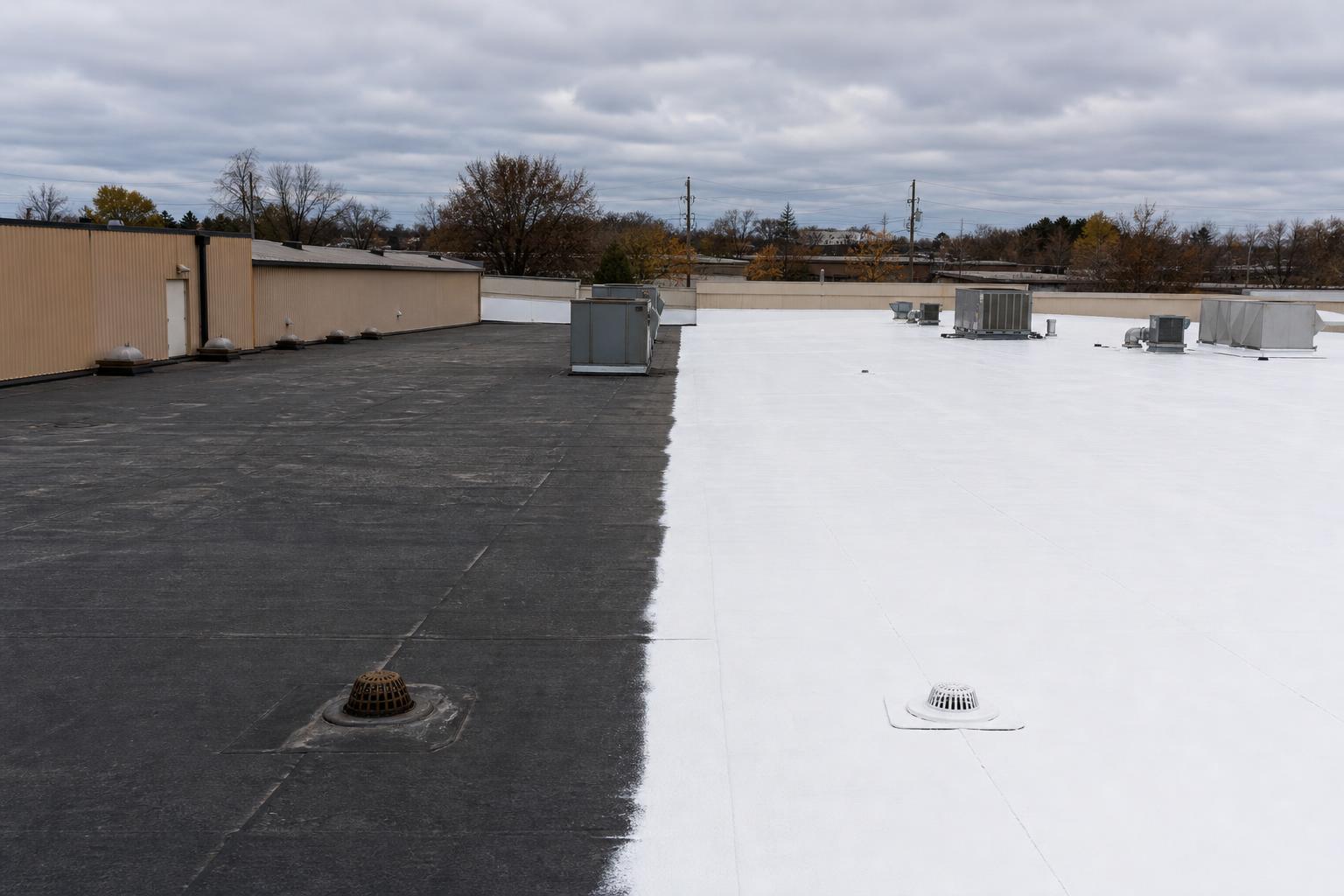
When the roof is past the point of spot repair, the budget conversation shifts to restoration or replacement. On a commercial flat roof with a sound deck and dry insulation, a manufacturer-warranted restoration system runs $4 to $6 per square foot. Full replacement runs $8 to $12 per square foot once tear-off, disposal, and new insulation are counted. On a 20,000 square foot roof that is the difference between roughly $100,000 and $200,000, and restoration keeps the building open while it happens.
Michigan-Specific Winter Line Items
Standard budgeting advice covers the basics. Michigan requires a few additional line items that property managers outside the state do not have to think about.
Ice Dam Removal
Professional removal runs $400 to $2,400 per incident depending on method and severity. Steam removal is the safest option for the membrane and runs $400 to $900 per hour with a two-hour minimum. Manual chipping costs less at $200 to $300 per hour but carries real risk of membrane damage.
Snow Removal
Snow removal from large commercial roofs ranges from $200 to $600 for standard buildings. Michigan building codes require roofs to handle 30 to 60 pounds per square foot. Older buildings that have not been updated to meet those standards are the ones most likely to have problems.
Drain and Scupper Heat Trace
Heat trace on drains, scuppers, and gutters keeps drainage paths open during deep freezes and prevents ice dams from forming. Expect $10 to $20 per linear foot. It pays for itself the first time it stops an ice dam.
Which Membrane Costs Less to Own in Michigan
The membrane on the roof directly affects how much you will spend maintaining it.
EPDM
EPDM is widely considered the most forgiving flat roof membrane for Michigan. It stays flexible in sub-zero temperatures and its dark surface absorbs heat, which helps melt snow faster and reduces load buildup. Seams are its weak point and they open with age, which is exactly what a restoration coating addresses.
TPO
TPO is popular for energy efficiency and is widely specified across Michigan. It performs well but is less flexible than EPDM in extreme cold. For Michigan conditions, TPO needs quality insulation underneath and properly heat-welded seams. Cut corners on either and winter thermal contraction will open seam failures over time.
Built-Up and Modified Bitumen
Older built-up roofing and tar systems are more expensive to maintain than modern single-ply membranes. Labor and material costs are higher and the repair process is less straightforward. These roofs are strong candidates for a silicone restoration system rather than continued patching.
Commercial Roof Budgeting Rules That Hold Up
Reactive budgeting costs more than planned maintenance. That is true everywhere, but especially in Michigan, where one bad winter can trigger multiple repair events in a short period.
Follow the 8 Percent Rule
Budget roughly 8 percent of the roof's replacement value annually for maintenance and repairs. For Michigan commercial properties that figure holds up well because it covers spring and fall inspections plus the minor repairs they surface.
Carry a Contingency
Beyond the baseline maintenance budget, carry a contingency of 10 to 20 percent on top of projected repair costs. Roofing repairs regularly uncover additional problems once work begins. Rotted decking under a membrane, saturated insulation, or corroded fasteners are common discoveries that were not visible from the surface. Contingency funds mean those discoveries do not stop the repair mid-project.
Get a Budget-Grade Number Before the Fiscal Year Closes
The cleanest way to get a roof into next year's capital plan is a written inspection report with a budget-grade estimate attached. We provide these at no cost for West Michigan commercial buildings. Schedule the inspection in late summer or early fall so the number is on your desk for Q4 budgeting, then re-inspect for firm pricing when the project is funded.
How Often Should a Michigan Commercial Roof Be Inspected
Twice a year is the standard. Once in spring after winter stress and once in fall before temperatures drop. Michigan's freeze-thaw cycles create seam stress and moisture intrusion that build gradually, and an infrared moisture survey every few years tells you what is happening under the membrane before it becomes a replacement.
Final Thoughts
Budgeting for commercial roof repair in Michigan is not complicated, but it does require planning beyond what property managers in milder climates have to consider. Snow removal, ice dam mitigation, moisture scanning, and membrane-specific maintenance all belong in the annual budget before anything goes wrong.
The property managers who handle Michigan winters best are the ones who plan for them in advance. Regular inspections, the right membrane, a contingency fund, and a written budget number in hand before the fiscal year closes keep roof costs predictable and keep small problems from becoming capital projects.
Published by Flat Roof Waterproofing Solutions -- certified industrial roofers serving commercial properties across West Michigan. Based in Grand Haven, MI. Call (616) 947-7652 to schedule a free inspection.