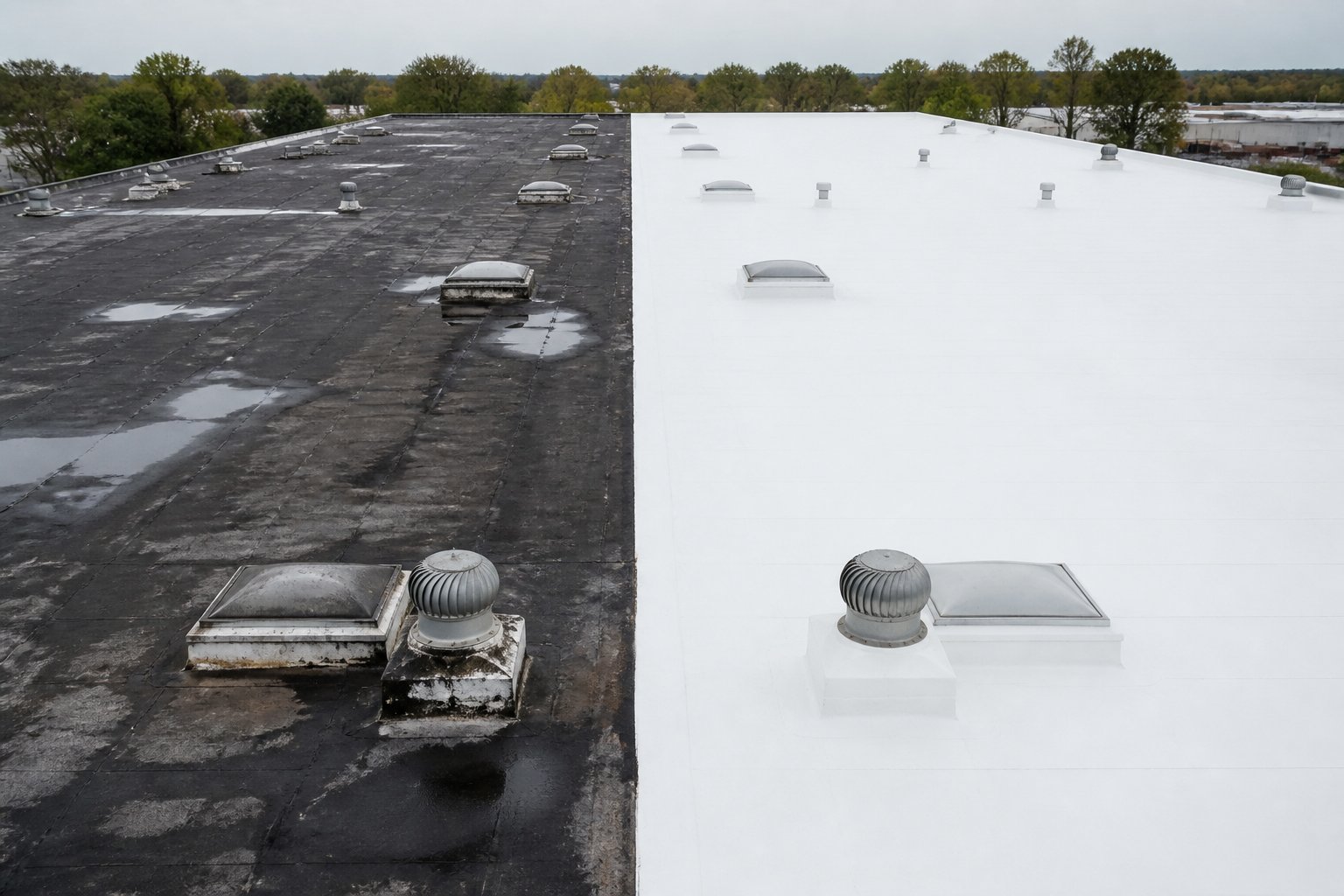
Roof restoration or replacement? Before committing capital to a full replacement on a Michigan commercial building, restoration deserves a hard look. Here is how building owners and facility managers decide.
Roof Restoration or Replacement: What Michigan Building Owners Need to Know
Michigan commercial roofs take a beating that roofs in most other states simply do not face. The freeze-thaw cycles here are relentless. Water gets into seams and flashing transitions, expands when it freezes, and pulls the assembly apart from the inside. Do that repeatedly over 15 or 20 winters, and even a well-installed membrane starts showing serious wear.
When that happens, most building owners and facility managers face the same question. Is it worth restoring what is there, or is it time to replace the whole system?
The answer depends on how old the roof is, how extensive the damage is, and whether the deck and insulation are still sound. Getting that assessment right is the difference between spending $4 to $6 per square foot on a restoration that buys another 15 to 20 years and spending $8 to $12 per square foot on a replacement the roof may not have needed.
Roof Restoration vs Replacement Cost for Michigan Commercial Buildings
The cost difference between restoration and replacement in Michigan is significant.
On a commercial flat roof, restoration typically runs $4 to $6 per square foot. Full replacement runs $8 to $12 per square foot once tear-off, disposal, new insulation, and the new membrane are counted. On a 20,000 square foot roof that is roughly $80,000 to $120,000 for restoration against $160,000 to $240,000 for replacement. Restoration generally costs 40 to 60 percent less than replacement for the same roof, and the building stays open while it happens.
The cost difference is real and meaningful. But choosing restoration purely because it costs less without checking whether the roof actually qualifies is a mistake that leads to paying for both restoration and replacement within a few years.
When to Restore a Flat Roof or Sloped Roof in Michigan
Restoration makes sense under specific conditions. It does not make sense to others.
Restoration
Choose restoration if the roof is under 20 years old, the deck is structurally sound, and the insulation is dry. Surface-level problems like seam wear, minor leaks, isolated cracking, or chalking are exactly what restoration is designed to address. A professional cleaning followed by targeted seam and flashing repairs and a manufacturer-approved coating system can extend the roof's functional life by 15 to 20 years at a fraction of replacement cost, with no tear-off and no interruption to the tenants below.
Restoration is also worth considering if you want to improve energy efficiency. Reflective coatings reduce heat absorption during Michigan summers and help stabilize interior temperatures through seasonal extremes. For flat roofs specifically, a silicone or urethane coating system applied over a structurally sound membrane is one of the most cost-effective ways to add years to the roof without tearing anything off.
Replacement
Choose replacement if the roof has exceeded 75% of its expected lifespan. If restoration costs are coming in above 30% of what full replacement would cost, replacement is the better financial decision. You are spending significant money either way, but only one option gives you a fresh start with a full lifespan ahead of it.
Visible sagging is a hard line. A sagging roof means the decking or structural supports underneath have been compromised, and no coating or surface repair addresses that. Widespread moisture damage, rot in the decking, and situations where more than 30 percent of the roof area is damaged all point toward replacement rather than restoration.
Freeze-Thaw Roof Damage in Michigan
Freeze-thaw roof damage is the defining factor that separates Michigan roofing decisions from those in warmer climates.
Here is what actually happens. Water from rain or snowmelt works its way into open seams, flashing transitions, or small cracks in the membrane. Temperatures drop overnight, and that water freezes. Frozen water expands with significant force, pushing materials apart and widening gaps that were barely noticeable before. Temperatures rise again during the day, the ice melts, and water runs deeper into the opening that just got larger. Then it freezes again that night.
This cycle repeats dozens of times each winter in Michigan. Over several years, it turns a minor surface issue into a structural one. Seams that looked fine in September can be lifting and separating by March. Flashing around HVAC curbs, drains, and parapets is particularly vulnerable because those are already transition points where materials meet, and small gaps exist.
This is why age matters so much in Michigan specifically. A 15-year-old EPDM roof in Georgia may have plenty of life left. The same roof in Michigan has been through significantly more stress and warrants a moisture survey before assuming restoration is enough.
Estimated Commercial Replacement Costs by Membrane in Michigan
If replacement is the right call, membrane choice drives the final cost and the service life.
- TPO runs roughly $8 to $12 per square foot fully installed with new insulation and carries a 20 to 30 year service life when seams are heat-welded correctly.
- EPDM lands in a similar range, handles cold exceptionally well, and is cost-effective on very large roofs where material cost dominates the budget.
- PVC costs somewhat more than TPO but brings chemical and grease resistance for food processing, kitchen exhaust, and industrial discharge.
- Modified bitumen and built-up systems are still installed on some buildings but cost more to maintain over time than single-ply membranes.
- Standing-seam metal for low-slope commercial applications runs $7 to $20 or more per square foot but can last 40 to 70 years.
For most Michigan commercial flat roofs, a heat-welded TPO or EPDM system over new tapered insulation represents the practical balance of upfront cost, lifespan, and freeze-thaw performance.
Final Words
Roof restoration or replacement? Start with an honest assessment of the roof's age, the deck, and the insulation, confirmed by an infrared moisture survey rather than a walk-over.
If the roof is under 20 years old, the structure is sound, and damage is limited to the surface, get a restoration quote. Compare it to what the replacement would cost. If restoration comes in under 30 percent of the replacement estimate, it is worth serious consideration.
If the roof is past 20 years, showing signs of structural compromise, or has damage covering a large portion of the surface, replacement is likely the more practical path, even if the upfront cost is higher. Paying for restoration on a roof that needs replacement just delays the larger expense while adding the cost of the restoration on top of it.
Published by Flat Roof Waterproofing Solutions -- certified industrial roofers serving commercial properties across West Michigan. Based in Grand Haven, MI. Call (616) 947-7652 to schedule a free inspection.