Ponding water is standing water that remains on a flat roof more than 48 hours after rainfall ends. It matters because a roof membrane under standing water ages faster, seams and flashings sit in moisture they were never designed for, and in Michigan the water freezes, expands, and works every defect open through dozens of cycles each winter. Ponding also adds dead load the structure may not have been designed to carry, and it is the most common reason an otherwise restorable roof ends up needing insulation replacement.
Every low-slope roof is designed to drain. "Flat" is a description of appearance, not of slope. When water stays, something in the drainage system has failed, and the fix starts with finding out what.
What causes ponding
Settled or crushed insulation
Roof insulation compresses over time, and it compresses unevenly. Foot traffic to rooftop equipment, the weight of the equipment itself, and years of snow load create low spots. Once a low spot forms, water collects in it, the added weight compresses the insulation further, and the depression grows. Insulation that has absorbed water compresses fastest of all, which is why ponding and wet insulation tend to be found together.
Blocked or undersized drains
Roof drains and scuppers clog with debris, with gravel from a ballasted roof, with vegetation that takes root in a neglected corner, and with the ice that forms in winter. A drain strainer that has been knocked off, a drain bowl that has settled below the membrane, or a scupper that was never sized for the roof area all produce the same result. This is the most common and the cheapest cause to fix.
Inadequate slope
Some roofs were built with too little slope for their drain spacing, or the slope was designed correctly and lost when the building settled, when an addition was tied in, or when a re-roof added layers that changed the drainage pattern. Mechanical equipment added after construction creates dams. Crickets and saddles that should divert water around curbs were omitted or have failed.
Deflection
Long structural spans deflect under load. A roof that drained fine when it was built can develop ponding at mid-span as the structure takes on rooftop units, accumulated layers, and the weight of the ponded water itself. This one needs a structural assessment, not just a roofing one.
What ponding does to the roof over time
The damage is cumulative. In the first season, standing water accelerates UV and chemical breakdown of the membrane surface where it sits, and it holds dirt and biological growth against the surface. Acrylic coatings and some single-ply membranes are particularly sensitive to prolonged immersion.
As the membrane surface degrades, seams within the ponding area start to open. Water at a seam under hydrostatic pressure, even a few inches of it, enters faster than water that is merely running past. Once water is under the membrane, the insulation absorbs it, loses R-value, and compresses, which deepens the pond.
Freeze-thaw in Michigan
West Michigan turns ponding from a slow problem into a fast one. A pond that freezes expands roughly nine percent by volume. That expansion pushes on every seam, flashing, and membrane edge the ice is in contact with. When it thaws, water enters whatever the ice opened. Then it freezes again. A single winter on the lakeshore delivers dozens of these cycles. A roof that ponded through one Michigan winter without visible damage has usually been damaged below the surface anyway.
Ice also blocks drains that are otherwise clear, so a roof that drains in summer can pond through a January thaw, refreeze, and go through the whole cycle at the worst possible time of year.
The fix
There are three tools, used alone or in combination depending on the cause.
Drain remediation
Clear, repair, or replace drains and scuppers. Reset drain bowls that have settled. Add overflow scuppers or auxiliary drains where the roof area outruns drain capacity. Install crickets and saddles to move water around equipment curbs. This is the first move on any ponding roof because it is the least expensive and because the other two fixes depend on the drains working.
Tapered insulation
Where the cause is slope, settled insulation, or a depression that cannot be drained, tapered insulation board is installed to rebuild positive slope toward the drains. On a restoration project, tapered insulation is added over the existing roof in the ponding areas before the fluid-applied membrane goes on. On a replacement, the whole insulation layer is tapered by design.
Coating as a water-shedding layer
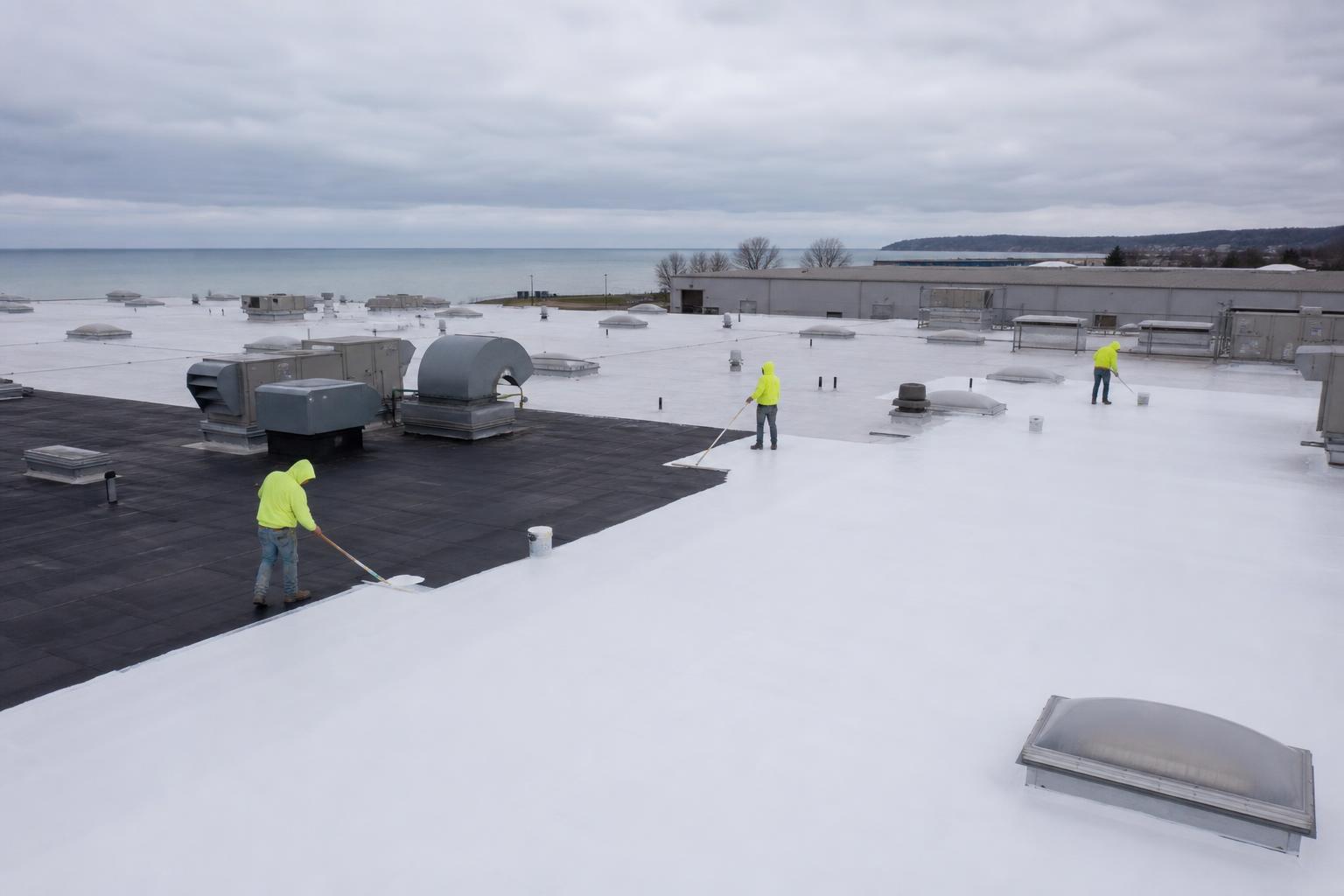
A silicone fluid-applied system tolerates ponding water far better than the membrane it covers, and it brings every seam and flashing in the ponding area under one continuous layer. It does not fix the slope, and we will not coat over wet insulation or a structural problem. But on a roof where the drains have been corrected, the wet insulation has been replaced, and some residual ponding remains, a silicone system is the right surface for it. Restoration with that system extends roof life 10 to 20 years, typically costs 40-60% less than replacement, and carries up to a 20-year warranty on qualifying roofs.
What to do now
If your roof holds water more than two days after rain, schedule an inspection before the next winter. The inspection maps the ponding areas, identifies the cause, surveys the insulation for moisture, and produces a written report with the fix and its cost. Flat Roof Waterproofing Solutions inspects commercial flat roofs across West Michigan from Grand Haven, MI. Call (616) 947-7652 or send photos and roof plans to [email protected].
FAQ
How much standing water is a problem on a flat roof?
Any water still standing 48 hours after rain stops is ponding by the common industry definition. Depth matters less than duration and the condition of the membrane under it.
Does ponding water void a roof warranty?
Many membrane and coating warranties exclude damage caused by ponding or require positive drainage as a condition of coverage. Check the warranty document for your specific system. Silicone fluid-applied systems are generally specified for ponding conditions; acrylic systems generally are not.
Can ponding be fixed without replacing the roof?
Usually. Drain remediation and tapered insulation address most causes, and a silicone fluid-applied system covers the result. Replacement is needed when ponding has already saturated the insulation across large areas or when the cause is structural deflection that requires reinforcement.
Is ponding worse in Michigan than elsewhere?
The consequences are. Freeze-thaw cycling turns standing water into a mechanical force on every seam and flashing it touches, and the lakeshore delivers many cycles per winter. The causes are the same everywhere; the timeline to damage is shorter here.
Published by Flat Roof Waterproofing Solutions -- commercial flat roof specialists serving properties across West Michigan. Based in Grand Haven, MI. Call (616) 947-7652 to request a roof assessment.