A commercial flat roof gets repaired when the problems are isolated and the system around them is sound, restored with a fluid-applied coating when the membrane is worn but the deck and insulation are dry, and replaced when the insulation is saturated across large areas, the deck is compromised, or the roof already carries multiple failed layers. The decision rests on four things we can measure during an inspection: age, membrane condition, insulation moisture, and structural integrity. Price comes last, not first.
Property managers ask us this question more than any other, usually after a second or third contractor has given them a second or third answer. The reason the answers vary is that most of them are made from the ground, or from a quick walk, without the data that actually decides it. Here is the framework we use.
Factor 1: Age and system type
Age sets expectations but does not decide anything on its own. A fifteen-year-old EPDM roof that has been maintained can be in better shape than a nine-year-old TPO roof that was installed badly and never looked at. What age tells us is where to look first. Older modified bitumen and built-up roofs tend to fail at the laps and at flashings as the asphalt oxidizes. Single-ply systems fail at seams, at the terminations, and wherever the membrane has been punctured by equipment service. Knowing the system type and the installation date tells us which failure modes to expect, and whether the roof is near the end of its original design life or still in the middle of it.
Factor 2: Membrane condition
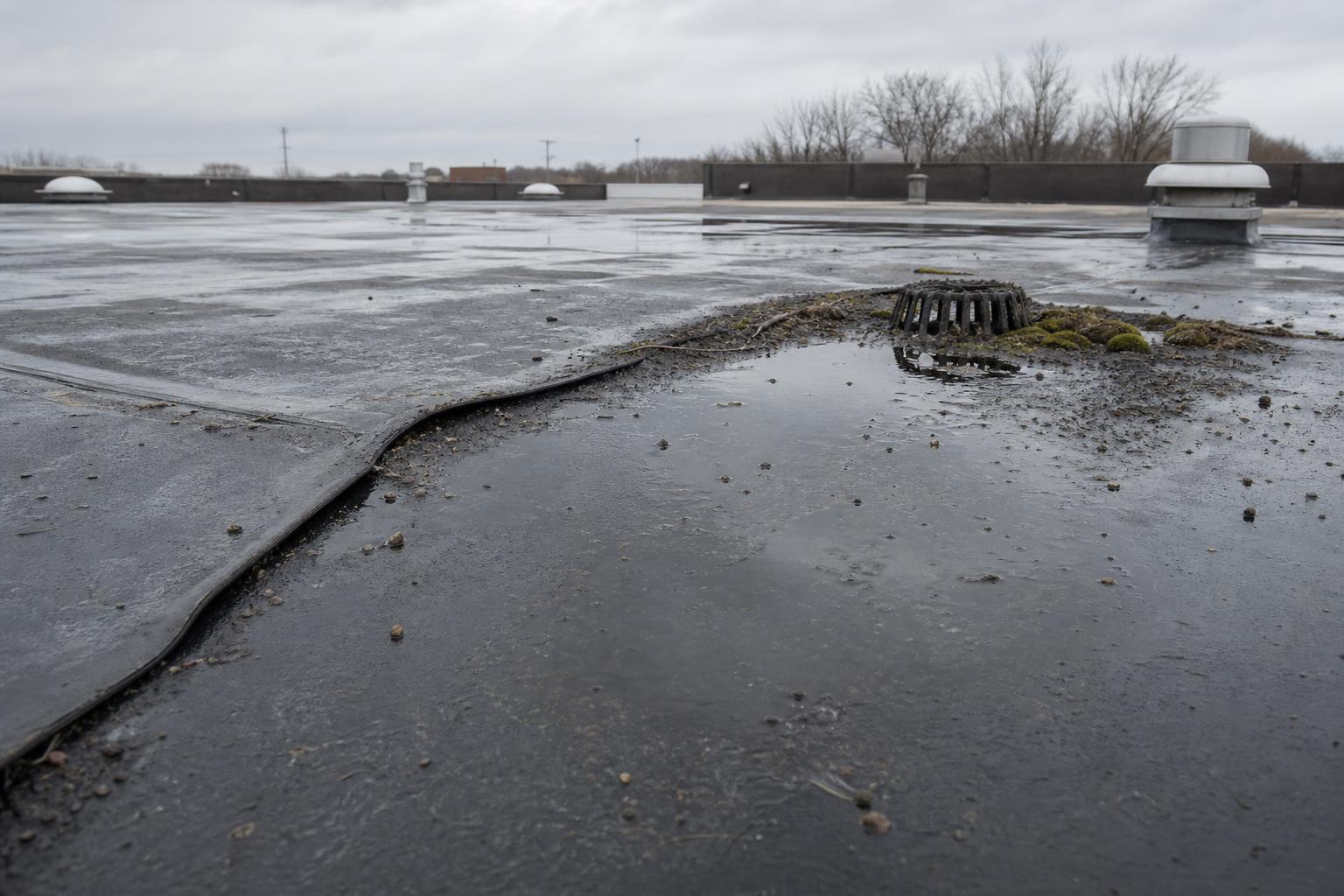
This is a surface assessment and it is the easiest part. We are looking at how much of the field is intact, how the seams are holding, whether the membrane has shrunk and pulled at the perimeter, how the flashings at curbs and penetrations look, and where the surface has lost its protective layer to UV. We also map ponding: areas where water stands more than two days after rain.
The question is whether the failures are isolated or general. A few open seams, a handful of bad penetrations, and a drain that needs resetting are repair items. Surface weathering across the whole field with seams that are still bonded is a restoration profile. A membrane that is brittle, cracked, and open across much of the roof has stopped being a substrate.
Factor 3: Insulation moisture
This is the factor that decides most cases, and it is the one that cannot be seen from the surface. A moisture survey maps where the insulation under the membrane has absorbed water. Wet insulation has lost its R-value, it adds weight to the deck, it corrodes metal decks and fasteners, and it will keep migrating.
Isolated wet areas can be cut out, replaced, and covered as part of a repair or restoration. Widespread saturation is the single most common reason a roof that looks restorable from the surface is actually a replacement. Coating over wet insulation traps the moisture and guarantees a failure, so we do not do it, and any contractor proposing a restoration without a moisture survey is guessing.
Factor 4: Structural integrity
The deck has to carry the roof. We check for rot in wood decks, corrosion and deflection in metal decks, and spalling or cracking in concrete. We check that the structure is handling the existing load, including any added rooftop equipment and the extra weight of wet insulation. A compromised deck ends the conversation about coating. It also changes the replacement scope, because deck repair or replacement has to be priced in.
Putting it together
With those four measured, the roof lands in one of three places:
Repair when the deck is sound, the insulation is dry, and the membrane problems are isolated. Repair is the right answer for a roof with years of life left and a short list of defects.
Restore when the deck is sound, the insulation is dry or wet only in isolated areas, and the membrane is weathered but intact across most of the field. Restoration with a fluid-applied system extends roof life 10 to 20 years, typically costs 40-60% less than replacement, and carries up to a 20-year warranty on qualifying roofs. Nothing is torn off and the building stays open.
Replace when the insulation is saturated across large areas, the deck is compromised, or the roof already carries multiple layers and cannot take another. Replacement costs more and is more disruptive, but it is the only honest answer for a roof in that condition, and it comes with a new insulation layer and a new design life.
There is a fourth outcome that is really a scheduling decision: repair now, restore in a planned budget year. A roof that is a restoration candidate does not have to be restored this quarter. Repairs keep it dry while the capital gets planned.
What this means for your budget
The sequence is inspection, moisture survey, written report, then price. Any number given before that sequence is a guess. The report documents the four factors with photographs, states which category the roof falls into and why, and gives cost ranges for the recommended path and the alternatives. Facility directors use it for capital planning, for lender and insurance documentation, and to make the repair-restore-replace decision on evidence rather than on which contractor was more persuasive.
Flat Roof Waterproofing Solutions inspects commercial and industrial flat roofs across West Michigan from Grand Haven, and select projects across the Midwest. Call (616) 947-7652 or send roof plans and photos to [email protected] to schedule an inspection.
FAQ
How do I know if my commercial flat roof needs repair or replacement?
You cannot know from the surface alone. The deciding factor is usually insulation moisture, which requires a survey. If the deck is sound and the insulation is dry, the roof is a repair or restoration candidate regardless of how it looks. If the insulation is saturated across large areas, it is a replacement.
Can a roof that has been patched many times still be restored?
Often, yes. Multiple patches tell us the roof has been leaking, not that it has failed. If the moisture survey shows the insulation is dry and the deck is sound, the patches are repaired properly and the field is coated. If the survey shows the leaks soaked the insulation, it is a replacement.
How much does restoration cost compared with replacement?
Restoration typically costs 40-60% less than replacement, because it eliminates tear-off, disposal, and new insulation. The written scope gives a figure for your building.
How long does a restored roof last?
A properly specified restoration extends roof life 10 to 20 years. Qualifying systems carry up to a 20-year warranty.
Is replacement ever the better financial choice even if restoration is possible?
Sometimes. If the building is being repositioned, if the insulation is marginal rather than clearly dry, or if the owner wants the longest possible reset of the roof's design life, replacement can be the right call. The inspection report lays out both paths so the owner can decide.
Published by Flat Roof Waterproofing Solutions -- commercial flat roof specialists serving properties across West Michigan. Based in Grand Haven, MI. Call (616) 947-7652 to request a roof assessment.