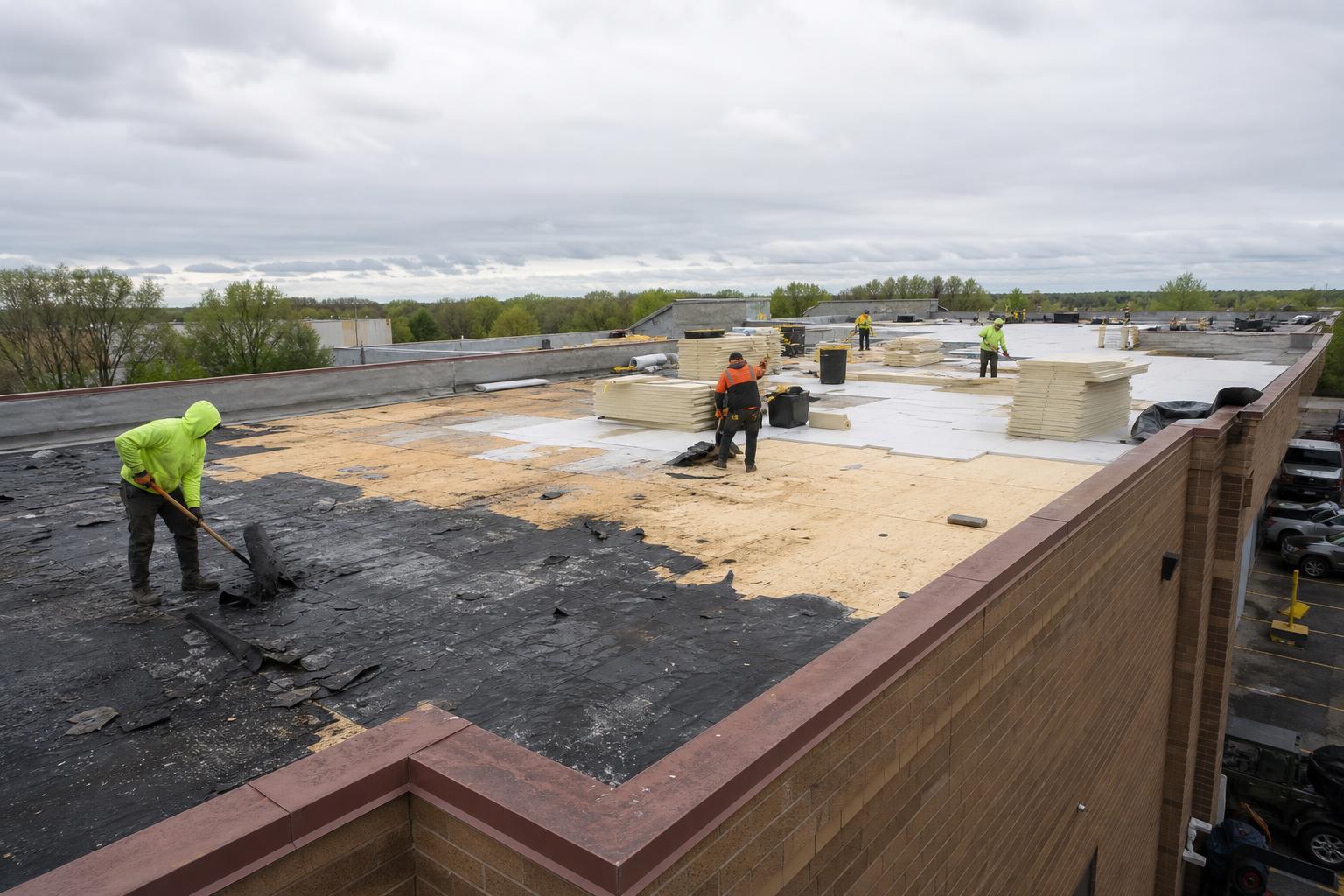
A flat roof leak never shows up at a convenient time. You find it during heavy rain, in the middle of winter, or the week before a lease renewal or a refinance inspection. In Michigan, leaks are especially common after heavy snowfall or rapid freeze-thaw cycles.
The good news is that not every flat roof problem requires a full replacement. The right repair depends on two things: what membrane is on the roof, and how far the damage has spread under it. Getting either one wrong is where most repair attempts fail. Here is how each commercial membrane type is repaired correctly, and when repair should give way to restoration.
Repair Methods by Commercial Membrane Type
EPDM (Rubber Membrane)
EPDM is one of the most common flat roof membranes on Michigan commercial buildings. Seam failures and flashing separation are its typical failure modes as the adhesive ages. Correct repair is a primed EPDM cover strip or patch bonded over the failed seam, not roof cement. EPDM performs well in Michigan winters, but on a roof with widespread seam wear, a seamless silicone restoration over the whole membrane is more cost-effective than chasing seams one at a time.
TPO and PVC (Thermoplastic Membranes)
TPO and PVC require heat-welded patches that fuse new membrane directly to the existing sheet. A standard adhesive patch will not hold long-term, and a torch is the wrong tool. Repair needs a hot-air welder and a technician who knows the correct temperature for the membrane's age. If the damage covers more than a small area, or seams are opening across the roof, a professional assessment is the practical next step.
Modified Bitumen
Small cracks and surface splits can be sealed with compatible bitumen-based compounds or a reflective coating. Larger splits usually need a torch-applied or cold-applied patch heat-bonded over the damaged section. That process carries a real fire risk on an occupied building and is professional work. Snow buildup and ice dams accelerate cracking on older modified bitumen roofs.
Built-Up Roofing (Tar and Gravel)
Built-up roofs blister, alligator, and split as the asphalt ages. Repairs involve cutting out blisters, re-mopping, and re-covering with compatible materials. These roofs are labor-intensive to keep patching, and they are among the strongest candidates for a silicone restoration system that seals the entire surface in one application.
Metal Low-Slope Roofs
Fastener back-out and seam separation are the usual causes. Repair means replacing fasteners with oversized gasketed screws and sealing seams with a metal-compatible sealant or seam tape, then often a full elastomeric coating to seal the whole surface.
Repairing a Flat Roof in Cold Weather
Cold weather makes flat roof repair harder than most people expect. Standard sealants often will not cure properly when temperatures drop close to freezing, and applying them anyway just delays the problem.
- All-weather sealants formulated to bond to damp surfaces and cure near freezing cost more than standard products but actually work when the weather is not cooperating.
- Butyl or bitumen tape sticks in wet conditions and provides immediate waterproofing. Think of it as damage control until dry weather allows a permanent repair.
- MMA-based resin systems cure fully in under two hours regardless of cold. They are more expensive and less forgiving to apply, but they deliver a reliable winter repair when nothing else will.
The Professional Repair Sequence
- Locate the entry point with visual inspection and infrared moisture scanning, since water travels under the membrane before it drops.
- Confirm insulation condition. Wet insulation has to come out or the repair fails from underneath.
- Clean and prepare the surface. Dirt, loose material, and old failed patches are removed.
- Apply the repair material that is compatible with the membrane: cover strip for EPDM, heat weld for TPO and PVC, compatible patch for modified bitumen.
- Reinforce transitions at flashings, curbs, and corners where movement concentrates.
- Document the repair with photographs and a written report for warranty, insurance, and maintenance records.
When Repair Should Give Way to Restoration
If the damage is limited to one or two spots, repair is the right call. If seams are opening across the roof, the surface is chalking or alligatoring, or you have called for repairs more than twice in two years, the roof is telling you it has reached the end of spot repair.
At that point the question is restoration or replacement. On a roof with a sound deck and dry insulation, a manufacturer-warranted restoration system at $4 to $6 per square foot adds 15 to 20 years of life with a 20-year warranty, applied over the existing roof with the building open. Replacement at $8 to $12 per square foot is reserved for roofs with saturated insulation or a compromised deck.
FAQs
How do I know if my commercial flat roof needs repair or full replacement?
If the damage is limited to one or two spots and the insulation is dry, repair. If leaks are appearing in multiple interior areas, ask for an infrared moisture survey. Widespread wet insulation points to replacement; a dry roof with widespread surface wear points to restoration.
Can our own maintenance staff repair a commercial flat roof?
Clearing drains and scuppers and photographing conditions is appropriate in-house work. Heat-welded membranes, torch-applied patches, and anything involving wet insulation should go to a certified commercial roofer, and unapproved repairs can void a manufacturer warranty.
How long does a commercial flat roof repair last?
A properly executed repair on a sound membrane can last five to fifteen years. Use materials compatible with the specific membrane, prepare the surface correctly, and fix the entry point rather than the stain.
Published by Flat Roof Waterproofing Solutions -- certified industrial roofers serving commercial properties across West Michigan. Based in Grand Haven, MI. Call (616) 947-7652 to schedule a free inspection.